Many people say that a single Polish word can have countless forms. And indeed: Polish numerals come in a whole range of variants!
Why does one word have so many forms?
This is mainly because Polish is an inflected language. While other languages use articles, for example, to express gender, number or certain grammatical relationships, Polish takes over many of these functions with endings and other forms of inflection. On top of that, there are stem changes and other alternations that make things a little more complicated. Suddenly a word can look completely different from the way you originally learned it!
So you end up with a fairly long list of forms: dwa, dwie, dwaj, dwóch, dwoje, dwojga, dwóm, dwojgu, dwiema, dwoma, dwojgiem and so on.
The forms in the nominative
To make things clearer, we first need to organise the different forms a little.
Let's start with the nominative. Here the form depends mainly on the grammatical gender of the noun being counted and on whether it is a male person.
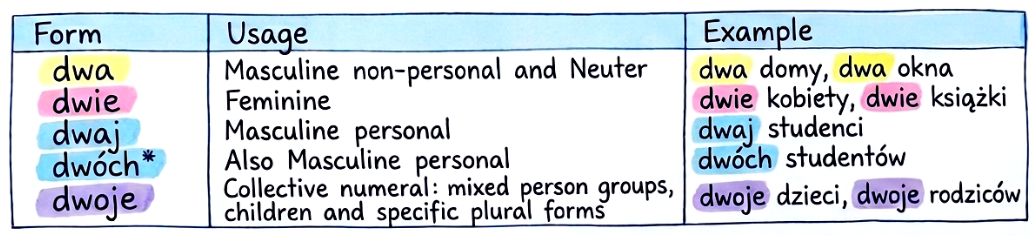
*dwaj or dwóch?
Important: dwaj and dwóch can both appear in the nominative, but they differ in usage and, above all, in the form of the noun that follows.
For example, you say dwaj studenci (the word studenci is in the nominative plural), but dwóch studentów (the word studentów is in the genitive plural).
dwoje – the collective numeral
And what about dwoje? This is a so-called collective numeral. It is used, among other things, for groups made up of people of different genders, for children, and for certain nouns that, grammatically speaking, exist only in the plural in Polish even though they refer to a single object (so-called pluralia tantum). One example is dwoje drzwi (“two doors”). But you can also simply say jedne drzwi (“one door”).
As with dwóch, the collective numeral dwoje requires a noun in the genitive: dwoje rodziców. The ordinary plural form, by contrast, is rodzice (nominative plural).
Singular or plural?
The use of dwóch and dwoje brings with it another grammatical peculiarity: although both forms refer to two people or things, the verb in these constructions is in the singular.
Compare:
- Tu są dwa domy.
- Tu są dwie kobiety.
- Tu są dwaj studenci.
But:
- Tu jest dwóch studentów.
- Tu jest dwoje dzieci.
“Two worlds and there are two of us”
Są dwa światy i nas jest dwoje – that is how Maryla Rodowicz sang. A sentence that sums up today's grammar topic quite well. :D
Let's take a closer look:
- Dwa – świat (world) is masculine and non-personal, so we use dwa. The verb są is in the plural here because the subject dwa światy refers to several worlds.
- Dwoje – because we are talking about a woman and a man, that is, a mixed group of people. That is why we use the collective numeral dwoje. The form nas is the genitive of the personal pronoun my (we). The verb jest is in the singular.
Isn't it much nicer to listen to music than to analyse tables? ;)